Teaching for transfer: Transfer of whose learning?
Jennie Bickmore-BrandMurdoch University
Kim Pitts-Hill
Swan Education District

[ Proceedings Contents ] [ Schedule ] [ Abstracts ] [ WAIER Home ]
Teaching for transfer: Transfer of whose learning?Jennie Bickmore-BrandMurdoch University
Kim Pitts-Hill |
|
The research findings from each of the classrooms in this study raise important issues when applied to two current popular practices in education namely the employment of group work and the use of heuristics to enhance student learning. In regard to employing group work to enhance student learning, these research findings revealed that classroom dynamics and teacher-student relationships can actually work against achieving positive effects from group-work activities and problem-solving. The second trend, particularly employed in the mathematics, language and science areas is that of teaching heuristics to enhance student learning. These research findings revealed that the problem-solving approaches of the students were so idiosyncratic as to question the validity or at the very least challenge the notion of transfer of heuristic frameworks to settings outside the taught context.
In Class C, data were collected over a three-month period using written, video and audio recordings by Pitts-Hill as a participant observer during the weekly lessons. Student and teacher talk in the lessons was transcribed and analysed. Stimulated recall interviews with the students in post lesson sessions was also transcribed. Discussions with the teacher clarified various points not clear from the transcribed data. Careful readings, supported by a MAKITAB learning interaction analysis system, and a NUD*IST analyses formed the basis of the data interrogation. The mathematics lessons in all three classes in the study required problem solving. The students either employed small group co-operative learning techniques to solve problems, or sat at tables of 4-6 participants that worked independently.
Habermas (1970, 1972, 1978, 1984) supports this emphasis away from each individual constructing meaning in an isolated environment, to a recognition of the individual as part of the social milieux. The classroom environment provides varied and complex opportunities for the social construction of meaning. As Bishop (1985) describes the individual-group relationships
...each individual person in the classroom group creates her own unique construction of the rest of the participants, of their goals, of their interactions between herself and the others and of all the events, tasks, mathematical contents which occur in the classroom. (p. 26)Consequently the classroom can be described as a culture in its own right. The "knowers" are bound with their culture, suggesting that all knowledge is mediated by social interactions. Social influences are a major determinant in what counts as knowledge in classrooms (see discussions from German interactionist literature, for example, Bauersfeld, 1988; 1992; 1995; Voigt, 1985; 1994; 1995). Knowledge is constructed "intersubjectively" and is socially negotiated between all participants in the classroom. The classroom climate that the teacher sets up for children's learning will not only reflect what the teacher knows (for example, about mathematics), but what he/she believes about how children learn (Lubinski, Thornton, Heyl & Klass, 1994).
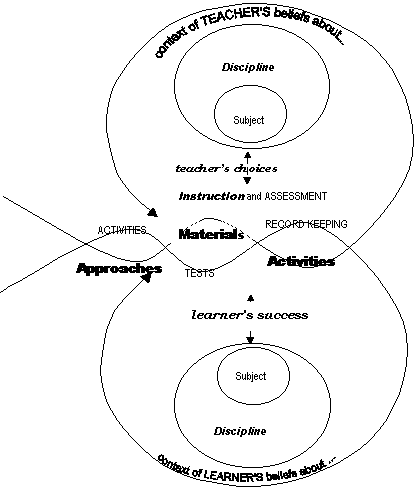
Teacher operations in the classroom are also influenced by the construct the teacher holds about a particular discipline and what is important to be learned from that discipline. The teacher also has understandings about how people learn this discipline and relationship of the subject within it and will therefore select learning materials which suit how they perceive students learn in that discipline. The teacher will assess the aspects of the subject they regard to be fundamental, thus providing cues to students about what is valued. The teacher's processes have in turn been shaped by the student's successes and responses within the learning environment she has created. This is shown in Figure 1. The figure is not intended to be linear but rather represent influences which filter back and forward in classroom interactions continually shaping the discourse.
|
Figure 1: How beliefs affect instruction
Thus learning is shaped through a negotiation and sharing of knowledge. Te acher's beliefs and practices are continually shaped by the experiences in the classroom. Teachers attempting to adopt constructivist ideas have aimed at establishing learning environments which nurture interest and understanding through cooperation and through social interaction which tolerates dissonance (Pateman & Johnson, 1990).
Much of the research into cooperative learning using small groups has concentrated on the nature of the task, the reward structures and student achievement but little insight has been provided into the role of the teacher's instruction or the content or the form of the student interactions. In a review of research Meloth, Deering and Sanders (1993) found that it was rare that teachers were reported as providing "information that would help students attend to and communicate, important lesson content effectively" (p.5). Furthermore, Meloth, Deering and Sanders (1993) found that fewer than 5% of studies in a review by Johnson, Johnson and Maruyama (1983) "examined the content of peer-group discussions, making it unclear whether the quality of students discussions contributed to learning gains (p.5)".
Traditionally, mathematics classrooms are very competitive places (Mousley & Clements, 1990), often characteristically different from other learning environments (Clarke & Clarke, 1990; Stigler & Baranes, 1988). Current educational reforms have influenced State curricula to now include notions of cooperative group learning in their materials. (See The Mathematics Framework document issued by the Victorian Ministry of Education (1988), the Western Australian Curriculum Framework, the Education Department of Western Australia's Student Outcome Statements (1995), and A National Statement on Mathematics for Australian Schools (AEC, 1990)).
Often cooperative learning is accompanied by the methodology of problem-based learning. Wheatley (1991) argued, as have Gooding and Stacey (1991), that the strength of problem-centered learning is that students can operate at their own cognitive levels and use their preferred learning styles. A major stumbling block for the implementation of cooperative learning in upper schools remains in the assessment area. Even when "who" and "what," is being assessed, has been made explicit at the outset, workload inequities continue to exist (Clarke, 1995).
Clearly, more research is needed on the role of cooperative group learning in the mathematics classroom. "How To ..." documents such as Dalton's (1985) "Adventures in Thinking," although very practical for group problem-solving across the curriculum, lack a strong research rationale. Ellerton and Clements (1991) raise the question that may need to be asked when applying cooperative learning in mathematics classroomsæunder what circumstances is peer discussion likely to be valuable? (p. 103). The research reported in this paper sheds light on the nature of peer discussion when classroom interaction patterns are analysed.
Probably the most explicit work concerning metacognitive classroom practices in mathematics education has come from Cobb (1990b). He listed four points to describe metacognitive approaches:
A teacher's explicit and often ritualistic rephrasing and refining of the learner's expressions at times forms part of what Furniss and Green (1991) term a "joint construction" (Furniss and Green also refer to the dialogue as "aided instruction" or "collaborative construction" (p. 48). Leinhardt and Putnam (1987) use the descriptionæ"lesson parser" which signals to the students recognisable parts of the lesson which they can expect to experience. Pateman and Johnson (1990) also note that this dialogue is based on responses from learners, who in turn are being given feedback about their processing and expression. Chapman (1992) refers to a teacher signaling ways of speaking that are appropriate to a particular subject-area, and that these are developed as part of the social practices of the classroom (p. 41).
Some typical routine heuristics used in Class A were: Guess and Check, Draw a Picture, make an Organised List, Make a Table, Work Backwards, Look for a Pattern, Use Logical Reasoning. A problem solving strategy regularly used in both Class A and C had been modelled after Polya's (1981) four phase framework (1. Understand the problem, 2. Devise a plan, 3. Carry out the plan, and 4. Look back and check). The problem solving heuristic was presented as a list of key words or phrases at times supported by diagrams that guided the student in solving the problem. Class C of this study involved students responding to a problem by generating or proposing an idea, insight, explanation or answer; then negotiating, arguing and reacting to that suggestion before coming to a final recommendation about whether it should be included in the group's response to the task. Following this, students wrote or recorded the answer, and looked back and checked their work. In Class B the teacher was very concerned that the students not b e compelled to follow any one strategy and encouraged a range of problem-solving approaches, which were developed by the class as they constructed their understandings.
Most children come to school with well-established thinking skills which have enabled them to survive in a real and meaningful world (Young-Loveridge, 1989). Davies (1993) investigated factors which inhibited the idiosyncratic interpretations of experience and found, that although children began school confident in their own ability to perceive and reason independently, this independence increasingly deferred to the teacher's knowledge the further students moved through the school system. Observations of children performing real-life problem-solving tasks showed that children preferred to use their own routes or have their own strategies even when school routines have been taught and rehearsed (Ginsburg, 1982; Saxe & Posner 1983; Scribner, 1984). Carraher and Schlieman (1985) found that most students displayed a wide range of self-generated strategies and competencies in performing mathematical computations in real world settings (for example, as candy sellers on the streets of Brazil). These strategies and competencies are rarely evident in the classroom when the same students perform algorithms involving the same properties of the numeration system.
Students can be assisted by their teachers to become aware of what they already know (Novak, 1986) and to evaluate their thinking. In this way teachers can assist students to become empowered by their capacity to learn how to learn, and to recognise what works best for themselves. Noddings (1993) has concerns that "turning students loose 'to construct' will not in itself ensure progress toward genuinely mathematical results" (p. 38), hence the role of the teacher can be quite crucial.
The socio-constructivist model (Yackel, Cobb, Wood, Wheatley, & Merkel, 1990) encourages effective communication between teacher and student. Teachers that adopt this model assume that the student contributions will be personally meaningful and that teachers should assist the students to state their ideas in mathematically meaningful ways. The teacher's intention is to work with the students as they try to express the concepts with which they are grappling. The teacher's interactions overtly model dialogue about mathematical issues for the students.
In order to be successful, students need to turn their language and their thinking upon themselves, so that they are not only able to direct their own thought processes, but they are also able to distinguish between possible interpretations of what they hear (Wilson & Wing Jan, 1993). Students may also find it helpful if they are able to represent their ideas in other forms which are less dependent on the context from which the information was originally drawn (Dalton, 1985; Dalton & Boyd, 1992).
The Class B teacher attempted to develop her students' metacognitive approaches through the integration of the mathematical ideas with real life situations in a problem-based approach. The teacher's intent was to raise the students' awareness of being critically literate about their mathematical processing (critically numerate).
In Class C the teacher aimed to teach a general problem solving heuristic or set of steps for solving problems. This is shown by Figure 2.

|
In Class C students were expected to use the heuristic while working in small groups of four on a common task. Before beginning the task the students were taught how the diagram showed the general nature of solving a problem. The teacher explained that in discussing the problem early ideas of how the problem could be solved would arise. These ideas would be discussed further by the group and be either accepted or rejected as part of the solution to the problem. If the idea being discussed was accepted as being part of the solution, it was recorded (generally on paper) then checked for group agreement that it was still part of the solution. A review of the heuristic was conducted briefly at the start of each lesson prior to students setting to work on the mathematical tasks.
Both Classes A and B were given a novel task to complete ("On what day and on what year will your 21st birthday fall?"). In Class A, where major heuristics had been taught, there was little demonstration of any predisposition to use the heuristic over that of Class B. In Class A there were only three (3) students that demonstrated any use of a system to solve the problem. In Class B, where the heuristic was not taught, eight (8) students appeared to use a system starting on the day on which they were born.
Regardless of whether the children knew what happened in a leap year or calculated the answer correctly, all children in Classes A and B demonstrated an almost idiosyncratic way of solving the problem. There were only two students from each of Class B and Class A that solved the problem without scaffolding assistance from Bickmore-Brand during the interview. There was no evidence to suggest that children from Class A, students that had been given explicit teaching about problem-solving strategies, actually applied them to this situation. Nor was there any evidence to suggest that Class A were more systematic than Class B who had experienced more real life opportunities to apply metacognitive strategies. Approximately one third of the students in Class B approached the task in a systematic way, whereas only three (3) students in Class A seemed to follow a strategy. In general Class A students were more willing to accept a prompt.
Clearly students failed to demonstrate any transfer of content previously taught in each of the classrooms. When analysing the post test (Placement Test J concept items- standardised test) for example, one third of Class B answered the questions on time and money incorrectly even though these spatial concepts had been explored within major problem-based topics throughout the year. One-third of Class A answered the question on decimals incorrectly, which also had been a major concept dealt with at regular intervals throughout the year. Ove r half of Class A made mistakes with the questions relating to number lines, even though they had had a considerable experience with number lines during the year.
The problem solving heuristic taught to students in Class C did not occur till later in the series of lessons observed. During the observation of lessons prior to the teaching of the problem solving heuristic, students participated in discussions and exhibited as much, if not more, evidence of using the elements of the problem solving heuristic than the lessons that followed the actual teaching of the heuristic. The evidence indicated that in conditions that did not explicate a problem solving heuristic or framework, students demonstrated effective problem solving strategies through verbal discussions within the small group learning context.
Following the introduction of a particular problem solving heuristic in Class C, it appeared that there was confusion in the student attempts to guide the problem solving process by following the model. In later situations where use of the heuristic may have aided the problem solving process, students did not attempt to utilise the model. In situations where the solution to a problem was reached early in the lesson, the students did not appear to have a clear recollection of the process by which the solution was obtained or in fact if they had made use of the heuristic framework at all. These findings are supported by Ross, Rolheiser and Hogaboam-Gray (1996) who found that students preferred to use their own procedures and instruments, rather than those developed by exemplary teachers. Given a choice, students may prefer to follow their instincts in solving problems.
One view (D.J. Clarke, personal communication, April, 1996) posits that students that are good problem solvers may naturally make use of problem solving heuristics. That is, good problem solvers have developed, either intentionally or unintentionally, a method or framework for solving problems. Following the teaching of the problem solving heuristic, students engaged in further problem solving tasks and were encouraged by the teacher to use the heuristic to guide their processes. As was apparent in the post lesson interviews conducted in Class C, most students indicated that there was nothing more they could see to learn about the problem solving heuristic. If students understand the essential elements of an heuristic (in this case, "idea", "discussion", "acceptance", "rejection", "writing" and "recording") and the interaction among those elements, then there may be little else that can be highlighted that will help students to solve problems. As one student stated "we always do that anyway".
Had the study of Class C sought to develop a problem solving heuristic, one source of data may have been the analysis of untrained student problem solving. In like manner, if our understanding of problem solving heuristics, frameworks and guiding questions has developed from the study of effective learners and problem solvers, it is not surprising then, to find these processes already occurring.
In this segment of lesson transcript from Class C, students were designing a bridge to hold a three kilogram weight (representing cars). Up until this point the students had been engaged in ideas, negotiating and arguing, agreeing and rejecting, recording and checking. This had occurred in no particular order, for 32 minutes. From this time on the teacher's input shifts the students' concentration from the seeking of a solution that will satisfy the problem to trying to guess the answer they think the teacher has in mind, as shown by the following passage. This is evident in Bryce's comment "hey wait, wait, he said it might be the other way round,"
|
|
The dialogue shows only the audible, literal, words uttered by the students. Of course many other sounds, gestures and non-verbal movements are made that contribute to the communication between and among the members of the group. The speed at which the dialogue occurs is astounding. Many thoughts and contributions are made often with split second timing, the difference between heading in one direction and another is often only effected by a short "burst" of talk, a word or part of a sentence. Much like a "willy willy" (an Australian term meaning miniature hurricane) the group revolves at incredible speed but travels forward at a much lesser speed. Sometimes it seems as though students are tuned into the thoughts of others in their group and know where the discussion is heading and when their contribution is accepted as part of the solution and when it is not. The problem solving heuristic seems to be in use but not in an overt and explicit manner. The social construction of meaning takes precedence.
Furthermore by suggesting potential clues as to a solution the teacher has shifted the nature of the problem to one that is more closed, having a definite solution, a solution that other groups may have already attained, and a solution to which this group are very close. Up until this point the high number of student proposals of ideas, negotiations and arguments, reviews and recordings had caused a high quality of discussion.
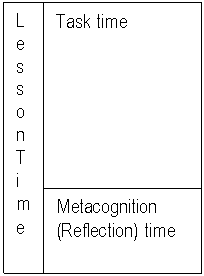
It is clear that the nature of the teacher's role must be carefully understood so that the quality of student discussions is allowed to continue at appropriate times. Secondly the time for debriefing or explicitly discussing metacognitive thinking may be better placed at the conclusion of lesson task time rather than midway through a task. Students may make significant gains if a more structured approach to teacher input allowed clear times or parts of the lesson, when metacognitive processing would be explicitly discussed. This may be shown by Figure 3.
|
The differences for the Class A and Class B teachers lie in how each scaffolding dialogue was constructed. Class A teacher signalled her preferred pathway for the development of a concept, and although clearly aware of a student's misunderstanding continued to drive on with a predetermined method for approaching that skill or concept as can be seen in this transcript excerpt.
|
The teacher in Class B however shaped and developed a skill or concept by moving down a jointly constructed pathway between her and the student or class. She worked with student ideas as they came up, for example in the following transcript, Joe wanted the sandwiches cut diagonally, and Ben suggested quarters. Her explanation of a skill or concept continued to be reworked in an effort to refine the communication of the idea rather than presenting a system for approaching the task.
| ||||||||||||||||||||||||||||||||||||||||||||||||||||||||||||||||||||||||||||
The teacher in Class B has attempted to develop the students' fraction knowledge in a context which is purposeful for the students. In addition, the concept has been tempered with a critical numeracy understanding of the skills they are using ("Some people don't like sandwiches").
Over the longer time period, Class A teacher continued to raise the difficulty of the concept development. Increased demands were placed on the students to apply their conceptual understanding of fraction concepts whereas, Class B teacher tended to focus on the immediate conceptual difficulty the children were facing as they tried to solve the problem they were currently tackling.
In Class C the teacher asked questions of the target group in relation to the heuristic as discussed above. The students were required to indicate on the heuristic model where the group was operating, however generally this did not result in any significant discussion and did not provoke any further reflection from the teacher or the students. Conversely, students were aware that if they did not achieve success in a task the teacher was quite likely to help them with clues or possible strategies. On a few occasions the teacher refocussed the students on the problem solving heuristic and the stage at which the students were operating. This had the effect of guiding the students in the solving of the problem, for example, by suggesting that if the group was satisfied they had completed the discussion of an aspect then they should seek agreement to accept or reject the idea. However, it was apparent that the level of teacher scaffolding was insufficient.
The findings from this study indicate that it is important not only for teachers to scaffold clear structures for thinking, but to also scaffold clear times and opportunities for thinking development. Student and teacher construction of an agreed process for thinking development appears to be an important step in the learning process.
Had the teachers in this study demonstrated using the heuristic to solve a problem they needed solving, thus modelling the implied processes and strategies of the heuristics and metacognitive strategies as genuine users, students may have achieved even higher levels of problem solving success. For example, if the teacher in Class C had encouraged the students to monitor similarly their progress according to the heuristic on a regular basis, higher levels of problem solving success may have been achieved by students. Similarly, if students had been encouraged to take an active leadership role in solving the problem through directing the problem solving strategies of the group, solutions to problems may have been achieved more effectively. Class C teacher modelling of regular reflection on the group's position on the model may have also encouraged students to take on a group monitoring role. Regular reflection may also have encouraged higher levels of recording and questioning. Teachers should also develop an understanding through observation of the variety of discussions that students create. This understanding impacts upon teacher planning of time for activities, the content of lesson problems, the need for student expertise and experience and the general culture that needs to be created in order to foster rich problem solving discussions.
Alternatively, the Class B teacher attempted to develop her students' metacognitive approaches through the integration of the mathematical ideas with real life situations and tried to raise the students' awareness of being critically literate about their mathematical processing (critically numerate).
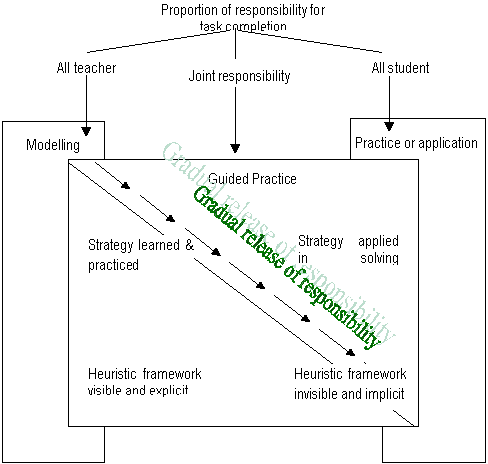
In Class C, it was apparent that the strategies used by students were not clearly linked back to the framework of problem solving that was taught. Further it was evident that the teacher did not clearly articulate these links to students. Had the general problem solving heuristic been taught in relation to specific problem solving strategies students may have exhibited far greater levels of achievement. This is shown by Figure 4.
| ||||||||||||||||||||||||||||||||||||||||
It would appear that the efforts by each teacher in this study to develop thinking strategies among their students was not as powerful a factor as allowing the students to use their own idiosyncratic ways when processing a problem. However, there was little evidence to suggest that the teachers in this study had recognised the power of student developed metacognition. In Class A, for example, students had experienced mainly textbook-oriented activities which had involved the application of a protocol or strategy. In Class B, students had a variety of lesson content but none of which expressly aimed to validate the students' own metacognitive practices. In Class C the teacher had pre-planned the series of lessons focussing on the teaching of the heuristic framework. It may be concluded that each teacher had pre-empted the needs of students to the extent that he or she was unable to see the opportunity of utilising student developed metacognition. The teacher was in effect preparing their students for "more of the same" - more of what they had been doing in the classroom. The implication here is that teachers need to spend specific time examining the nature of the student learning that is occurring in classrooms. In the current Western Australian educational climate this need for careful analysis of student achievement is supported by the move towards an outcome focussed learning environment and the promotion of developmental learning.
|
In this way learning has both a clear teacher input as to how problems may be solved but is supported and developed in the second stage where students undertake the solution of problems in more idiosyncratic ways.
Bauersfeld, H. (1988). Interaction, construction, and knowledge: Alternative perspectives for mathematics education. In D. A. Grouws & T. J. Cooney (Eds.), Perspectives on research on effective mathematics teaching (Vol. 1, pp. 27-46). Reston, VA: The National Council of Teachers of Mathematics.
Bauersfeld, H. (1992). The structuring of the structures. Paper presented at the International Symposium on Alternative Epistemologies in Education, University of Georgia.
Bauersfeld, H. (1995). Language games in the mathematics classroom: Their function and their effects. In P. Cobb & H. Bauersfeld (Eds.), The emergence of mathematical meaning: Interaction in classroom cultures. Hillsdale, NJ: Lawrence Erlbaum Associates.
Barrett, G. (1985). Structure of knowledge and the learner: An examination of cognitive learning skills, learning situations and knowledge. Cambridge Journal of Education, 15(2), 73-80.
Bickmore-Brand, J. (1998). Teachers of mathematics teach mathematics differently: A case study of two teachers. Unpublished PhD thesis, Edith Cowan University, Western Australia.
Bishop, A. (1985). The social construction of meaning-A significant development for mathematics education? For the Learning of Mathematics, 5(1), 24-28.
Boomer, G. (1988). Negotiating the curriculum: a student teacher partnership. Ashton Scholastic, Sydney.
Brown, A.L., & Palincsar, A.S. (1987). Reciprocal teaching of comprehension strategies: A natural history of one program for enhancing learning. In J. D. Day & J. Borkowski (Eds.), ntelligence and exceptionality: New directions for theory, assessment and instructional practice (pp. 81-132). Norwood, NJ: Ablex.
Burnes, D., & Page, G. (1985). Insights and strategies for teaching reading. Australia: Harcourt Brace Jovanovich.
Cairney, T. (1987). The social foundations of literacy. Australian Journal of Reading, 10(2), 84-96.
Carraher, T. N., & Schlieman, A. D. (1985). Computation routines prescribed by schools: Help or hindrance? Journal for Research in Mathematics Education, 16, 37-44.
Cazden, C. B. (1983). Adult assistance to language development: scaffolds, models, and direct instruction. In R. Parker & F. Davis (Eds.), Developing literacy: Young children's use of language (pp. 3-18). Newark, DE: International Reading Association.
Chapman, A. (1992). Language practices in school mathematics: A social semiotic perspective. Unpublished PhD thesis, Murdoch University.
Clarke, D. J. (1995). Teaching, learning and assessment: An essential symbiosis. In Critical Issues, Essential Priorities.Proceedings from 18th National Conference for the Australian Council for Adult Literacy (pp. 24-34). Melbourne: VALBEC.
Clarke, D. M., & Clarke, D. J. (1990). Classroom applications of research on co-operative learning in the mathematics classroom. In K. Clements (Ed.), Whither mathematics? (pp. 387-90). Melbourne: Mathematical Association of Victoria.
Cobb, P. (1990b). Multiple perspectives. In L. P. Steffe & T. Wood (Eds.), Transforming children's mathematics education: International perspectives (pp. 200-215). Hillsdale, NJ: Lawrence Erlbaum.
Dalton, J. (1985). Adventures in teaching. Nelson: Melbourne.
Dalton, J., & Boyd, J. (1992). I teach: A guide to inspiring classroom leadership. Eleanor Curtin: Melbourne.
Davidson, N. (Ed.) (1990). Co-operative learning in mathematics: A handbook for teachers. Menlo Park California: Addison Wesley.
Davidson, N., & Kroll, D. (1991). An overview of research on cooperative learning related to mathematics. Journal for Research in Mathematics education, 22, 362-365.
Davies, B. (1993). Shards of glass: Children reading and writing beyond gendered identities. Sydney: Allen & Unwin.
Ellerton, N. F., & Clements, M. A. (1991). The mathematics in language: A review of language factors in school mathematics. Geelong, Victoria: Deakin University.
Furness, E., & Green, P. (Eds.) (1991). The literacy connection: Language and learning across the curriculum. Victoria: Eleanor Curtain Publishing.
Ginsburg, H. (1982). The development of addition in contexts of culture, social class and race. In T. P. Carpenter, J. M. Moser & T. A. Romberg (Eds.), Addition and subtraction: A cognitive perspective (pp. 99-116). Hillsdale, NJ: Erlbaum.
Gooding, A. (1990). What children learn and do not learn in groups. In M. A. Clements (Ed.), Whither mathematics? (pp. 391-396). Victoria: Mathematical Association of Victoria.
Gooding, A., & Stacey, K. (1991). Aspects of knowledge development through interaction in small groups. In Proceedings of Theory of Mathematics Education Conference 5. Paderno, Italy.
Greeno, J. G. (1980). Some examples of cognitive task analysis with instructional implications. In R. E. Snow, P. Federico & W. E Montague (Eds.), Aptitude, learning and instruction, Volume 2: Cognitive process analysis of learning and problem solving (pp. 1-21). Hillsdale, NJ: Lawrence Erlbaum.
Habermas, J. (1970). On systematically distorted communication. Inquiry, 13(3), 205-218.
Habermas, J. (1972). Knowledge and human interests (2nd ed.) (J. J. Shapiro, Trans.). London: Heinemann.
Habermas, J. (1978). Legitimation crisis (T. McCarthy, Trans.). Boston: Beacon Press.
Habermas, J. (1984). A theory of communicative action: Vol 1. Reason and the rationalization of society (T. McCarthy, Trans.). Boston: Beacon Press.
Healy, H., Hoyles, C., & Sutherland, R. (1990). Critical decisions in the generalisation process: A methodology for researching pupil collaboration in computer and non computer environments. In G. Booker, P. Cobb & T. N. de Mendicuti (Eds.), Proceedings of the Fourteenth PME Conference, Vol 3, (pp. 83-90). Oaxtepec, Mexico: International Group for the Psychology of Mathematics Education.
Ginsburg, H. (1982). The development of addition in contexts of culture, social class and race. In T. P. Carpenter, J. M. Moser & T. A. Romberg (Eds.), Addition and subtraction: A cognitive perspective (pp. 99-116). Hillsdale, NJ: Erlbaum.
Holdaway, D. (1979). Foundations of literacy. Sydney: Ashton Scholastic.
Johnson, D., & Johnson, R. (1975/1994). Learning together and alone: Cooperative, competitive, and individualistic learning. Englewood Cliffs, NJ: Prentice Hall.
Johnson, D., Johnson, R., & Maruyama, G. (1983). Interdependence and interpersonal attraction among heterogeneous individuals: A theoretical formulation and a meta-analysis of the research. Review of Educational Research, 53, 5-54.
King, L., Barry, K., Maloney, C., & Tayler, C. (1993). A study of the teacher's role in small group cooperative learning during elementary mathematics lessons. Paper presented at the Annual Meeting of the American Educational Research Association, Atlanta, U.S.A.
Leinhardt, G., & Putnam, R. T. (19 87). The skill of learning from classroom lessons is not the answer: Mathematical knowing and teaching. American Educational Research Journal, 27(4), 557-588.
Lubinski, C. A., Thornton, C. A., Heyl, B. S., & Klass, P. H. (1994). Levels of introspection in mathematics instruction. Mathematics Education Research Journal, 6(2), 113-130.
Meloth, M. (1990). Changes in poor reader's knowledge of cognition and the association of knowledge of cognition with regulation of cognition and reading comprehension. Journal of Educational Psychology, 82, 792-798.
Meloth, M., Deering, P., & Sanders, A.B. (1993). Teacher influences on cognitive processes during cooperative learning. Paper presented at the Annual Meeting of the American Educational Research Association, Atlanta, Georgia, U.S.A.
Metcalf, J., & Shimanura, A.P. (Eds.) (1994). Metacognition: Knowing about knowing. Cambridge: The MIT Press.
Mousley, J., & Clements, M. A. (1990). The culture of mathematics classrooms. In M. A. Clements (Ed.), Whither mathematics? (pp. 397-406). Mathematical Association of Victoria.
Noddings, N. (1993). Constructivism and caring. In R. Davis & C. Maher (Eds.), Schools, mathematics and the world of reality (pp. 35-50). Boston: Allyn & Bacon.
Novak, J. (1986). Learning science and the science of learning. Studies in Science Education, 15, 77-101.
Palincsar, A., & Brown, A. (1989). Classroom dialogues to promote self-regulated comprehension. In J. Brophy (Ed.), Advances in research on teaching (Vol. 1, pp. 35-71). Greenwich, CT: JAI Press.
Pateman, N. A., & Johnson, D. C. (1990). Curriculum and constructivism in early childhood mathematics: Sources of tension and possible resolutions. In L. P. Steffe & T. Wood (Eds.), Transforming children's mathematics education: International perspectives (pp. 346-356). Hillsdale, NJ: Lawrence Erlbaum.
Pimm, D. (1987). Speaking mathematically: Communication in mathematics classrooms. London. Routledge.
Pirie, S. E. B., & Schwarzenberger, R. L. E. (1988). Mathematical discussion and mathematical understanding. Educational Studies in Mathematics, 19, 459-470.
Pitts-Hill, K. (1997). A descriptive study of the use of a problem solving heuristic in a cooperative small group setting. Unpublished Masters thesis, Edith Cowan University, Western Australia.
Polya, G. (1981). Mathematics discovery (combined paperback edition). New York: Wiley.
Ross, J.A., Rolheiser, C., & Hogaboam-Gray, A. (1996). Teaching students how to self-evaluate when learning cooperatively the effects of collaborative action research on teacher practice. Paper presented at the Annual Meeting of the American Educational Research Association, New York, U.S.A.
Saxe, G., & Posner, J. (1983). The development of numerical cognition: Cross-cultural perspectives. In H. Ginsburg (Ed.), The development of mathematical thinking (pp. 292-318). New York: Academic Press.
Sharan, S., & Sharan, Y. (1984). Cooperative learning in the classroom: Research in desegregated schools. Hillsdale, NJ: Erlbaum.
Schmuck, R.A., & Schmuck, P.A. (1983). Group processes in the classroom. Iowa: Wm.C.Brown.
Scribner, S. (1984). Studying working intelligence. In B. Rogoff & J. Lave (Eds.), Everyday cognition: Its development in social context. Cambridge, MA: Harvard University Press, 9-40.
Slavin, R.E. (1983). Cooperative learning. New York: Longman
Slavin, R.E. (1992). When and why does cooperative learning increase academic achievement? Theoretical and empirical perspectives. In R. Hertz-Larowitz, & N. Miller (Eds.), Interaction in cooperative groups: The theoretical anatomy of group learning. (pp. 145-173). Cambridge: Cambridge University Press.
Stigler, J., & Baranes, R. (1988). Culture and mathematics learning. In E. Rothkopf (Ed.), Review of Research in Education 15, (pp. 253-306). Washington, D.C.: American Educational Research Association.
Victorian Ministry of Education. Mathematics Framework. Melbourne, Victoria.
Voigt, J. (1994). Negotiation of mathematical meaning and learning mathematics. Educational Studies in Mathematics, 26, 275-298.
Voigt, J. (1985). Patterns and routines in classroom interaction. Recherches en Didactique des Mathematiques, 6, 69-118.
Voigt, J. (1995). Thematic patterns of interaction and sociomathematical norms. In P. Cobb & H. Bauersfeld (Eds.), The emergence of mathematical meaning: Interaction in classroom cultures. Hillsdale, N J: Lawrence Erlbaum Associates.
Wells, G. (Ed.) (1981). Learning through interaction: The study of language development. New Rochelle NY: Cambridge University.
Wheatley, G. H. (1991). Constructivist perspectives on science and mathematics learning. Science Education, 75(1), 9-21.
Western Australian Curriculum Framework, the Education Department of Western Australia's Student Outcome Statements (1995).
Wilson, J., & Wing Jan, L. (1993). Thinking for themselves: Developing strategies for reflective learning. Melbourne: Eleanor Curtain Publishing.
Yackel, E., Cobb, P., Wood, T., Wheatley, G., & Merkel, G. (1990). The importance of social interaction in children's construction of mathematical knowledge. In T. Cooney & C. R. Hirsch (Eds.), Teaching and learning mathematics in the 1990s. Virginia: NCTM.
Young-Loveridge, J. M. (1989). The development of children's number concepts: The first year of school. New Zealand Journal of Educational Studies, 24(1), 47-64.
| Please cite as: Bickmore-Brand, J. and Pitts-Hill, K. (1999). Teaching for transfer: Transfer of whose learning? Proceedings Western Australian Institute for Educational Research Forum 1999. http://www.waier.org.au/forums/1999/bickmore-brand.html |