Portable computers supporting secondary school learning
Paul NewhouseSchool of Education
Edith Cowan University

[ Proceedings Contents ] [ Schedule ] [ Abstracts ] [ WAIER Home ]
Portable computers supporting secondary school learningPaul NewhouseSchool of Education Edith Cowan University |
|
There are convincing arguments for the integration of computer applications into school programs but after more than 30 years of increasing investment there has been very little impact on the experiences of students in schools. In the 1990s, significant developments in computer technology have been the emergence of low-cost, high-powered portable computers, and improvements in the capabilities and operation of computer networks (e.g. Intranets and the accessibility of the Internet). It is not clear that these developments will have any more impact on school-based learning than any of the previous developments in computer technology. This paper discusses the findings of an initial three year evaluation of the use of portable computers in a secondary school in Perth, Western Australia, and information from a recent follow-up study. In particular the perceptions of students in their final year of secondary school will be presented. Most of these students have had a portable computer for all of their secondary school years.
Computer Saturated Learning Environments are those in which it is possible at any time for every student to access an adequate level of computer processing to allow them to apply software relevant to their learning needs. It concerns quantity and the term itself conjures the believe that perhaps this maximum quantity level may precipitate changes within the classroom. However, this does not imply that the focus should be on the quantitative. This needs to change from hardware and software, which Papert calls technocentric thinking (Rowe, 1993), to the processes of education, learning and students and teachers in classrooms.
| Table 1: The three cohorts used in the study, number of students, when data were collected for each cohort and the model of Macintosh computer used. | |||
| Cohort | Students | Data collection | Model of Macintosh computer |
| A | 38 98 | Year 7, 1993 Semester 1 Year 8, 1994 All year | Powerbook 100 Duo 230 |
| B* | 95 108 | Year 8, 1993 Semester 2 Year 10, 1995 All year | Duo 210 Duo 230 |
| C | 103 | Year 8, 1995 Semester 2 | Powerbook 150 |
* Note: The study also collected data on a small number of students from this cohort in Semester 1 of 1994. | |||
The purpose of the study was both investigative and evaluative and involved the researcher becoming immersed in the school environment. The study used both qualitative and quantitative data with each year focussing on those features of the environment which seemed to be important from an interpretation of data collected earlier. In 1995 the evaluation used aspects of the Concerns Based Adoption Model (CBAM) which is a model for implementing and evaluating any innovation in education. These data are not reported in this paper.
The degree and severity of technical problems seemed to relate more to the model of portable computer issued to that cohort of students. Many technical problems were related to a lack of knowledge and general management issues which could be overcome. However, from the students' perspective there were problems such as: excessive weight, short battery life, excessive startup time, and faults concerning screens.
From the teachers perspective problems included: students who needed access to power points, students getting print outs when required, and students who did not have a computer when required because either the computer had been forgotten or was in for repairs. In Year Eight in 1995 on average about 13% of the students had a computer in for repairs, which is about three students per class group.
Using teacher log sheets in 1993 the estimated average time spent in class using the computers per Year Seven student was 30 minutes per day. For the Year Eight students this was 50 minutes per day, except for the weeks when they were doing the computing unit. In 1995 Year Eight students estimated they would usually use the computers on average about 1 hour per day (large standard deviation).
Use at home was spread evenly over the week with estimates ranging between 0 and 9 hours in total with an average of between 2 and 5 hours per week per student (Table 2). The majority of Year Eight students used their computers regularly at home but a large numb er of students in Year Ten used the computers very little even at home (Figures 1, 2 and 3).
| Table 2: Estimated time spent using portable computers at home by students. | ||
| Cohort | Year | Mean |
| A | 7 8 | 5 4 |
| B | 8 10 | 2 1 |
| C | 8 | 3 |

Figure 1: Estimated amount of time spent using the computers at home by students from Cohort A in Year Eight.

Figure 2: Estimated amount of time spent using the computers at home by students from Cohort B in Year Eight and Year Ten.
Figure 3: Estimated amount of time spent using the computers at home by students in Cohort C.
In cohorts A and B the high level of game playing was an interesting phenomenon with most students who were interviewed admitting to an interest in computer game playing. There appeared to be a culture of computer game playing with game swapping over the network this was particularly the case with boarders. In most observed lessons a number of students played games at some stage, usually unknown to the teacher. However for Cohort C there was a relatively small use of games.
| Table 3: Percentage of students using a computer application often at home. | |||
| Application | Cohort C (Yr 8) % | Cohort B (Yr 10) % | Cohort A (Yr 8) % |
| Word processing | 87 | 82 | 82 |
| Graphics | 58 | 14 | 17 |
| Games | 31 | 27 | 50 |
| Hypercard | 12 | 12 | 11 |
| Spreadsheets | 5 | 4 | 10 |
| MacGlobe | 4 | 6 | 10 |
| Maths programs | 4 | 4 | 5 |
| Other uses | 7 | - | 6 (Typing Tutor) |
In Cohort B, about 20% of the students indicated a negative attitude to the use of the computers at the end of the year. When these students were in year nine it appeared that many had overcome their initial problems and only about a residual group of 5% remained. However, when this cohort was in Year Ten many of the students were not happy with the portable computer program (Table 4). Unfortunately it appeared that a significant number of the students had developed an undesirable attitude towards the use of computers. The interviews indicated that for many students this negative attitude was as a result of the perceived lack of use of the computers in class at school. There was also the opinion that students needed more computer training, which was seen as the responsibility of the school.
| Table 4: Student attitudes towards the portable computer program. | |
| Question/Statement | Students in affirmative |
| I couldn't do without my Macintosh. | 38% |
| Has it been successful where everyone has a computer at school? | 45% |
| I would like to use my Macintosh more at school. | 43% |
| I get worried when I have to use my Macintosh. | 11% |
One of the 24 students who were interviewed, used the computer a lot, and enjoyed doing so, but made the following comments.
"Make compulsory for use in classes so that you don't have to carry books around as well."In contrast, the students in Cohort C enjoyed using the computers and wanted to use them more (Table 5). Very few students were worried about using the computers and about half the students found the computers a necessary item. Most of these students appeared to develop a very healthy and helpful attitude towards the use of computers. They developed a sound appreciation for what they could and could not do on their computer and continually made decisions based on task related criteria to use, or not use, the computers. The successes of the program for Cohort C had been built on trials with the previous two cohorts. In interviews with 23 students some of their comments were:
"Teachers need to make allowances for computer use."
"Students need to experiment and make use of the computers by learning from other students. The majority of students are against it. It is a personal choice, the school can't do much about it. The facilities are really good."
"They are useful. Good for English. Work is neater and you can change things."
"Learn to use for workplaces."
"Easier to record notes. Can't lose work."
"It was risky at first but now it is easier than typing and saves on paper."
"I like it because I am good at computers and can fix my own problems. It is hard for some students."
"It is good and easier than writing, But I don't like being made to use computers. It should be a choice to use the computers."
"It is advanced but you need to get to know how to use them better.
"Last term my computer was being repaired for the whole term."
"It is OK but I am not good at typing."
"It is OK for projects but personally I don't like them and my friends don't."
"They are alright but are heavy and a hassle to carry on the bus."
"They are heavy to carry and might get stolen."
| Table 5: Year eight student attitudes towards the portable computer program in 1995. | ||
| % of students in affirmative | ||
| Question/Statement | August | November |
| I couldn't do without my computer. | 57 | 42 |
| Has it been successful where everyone has a computer at school? | 83 | 78 |
| I would like to use my computer more at school. | 47 | 38 |
| I get worried when I have to use my computer. | 4 | 4 |
The first cohort of Year Eight students (Cohort B) were not adept at working within the operating system but gained expertise as the need arises. No student backed up work every day and only 15% backed up a few times a week. By the end of Year Ten the perceptions these students had of their computer-related skills had improved they could perform most of the identified tasks independently (Table 6).
Clearly the perceptions of students in Cohort C of their computer-related skills is much improved on the other two cohorts. Of interest is the improved knowledge and skills in using Hypercard, spreadsheets and copying files. They were better at tasks involving the use of disks. This is not surprising since these students were the first to be provided with computers with built-in floppy disk drives. These students almost all backed up at least sometimes. About one quarter backed up a few times a week. In addition, 66% of the students claim to try to use all fingers to type, with about 68% suggesting they would like to learn to type well.
| Table 6: Comparison between year eight cohorts in 1995 (and Year 10), 1994 and 1993 on the number of students indicating they are able to complete a task independently. | |||||
| % of students able to complete task | |||||
| Cohort C | Cohort A | Cohort B | |||
| Task to complete | Nov '95 | Aug '95 | 1994 | 1993 | 1995 (Yr10) |
| Open a new document | 99 | 93 | |||
| Do a drawing on the screen | 99 | 92 | |||
| Copy a floppy disk | 96 | 74 | 62 | 86 | |
| Copy a file off the network | 96 | 94 | 76 | 87 | |
| Copy a file off another computer | 96 | 92 | 79 | 41 | 71 |
| Start a spreadsheet | 96 | 86 | 53 | 74 | |
| Print a document | 100 | 86 | |||
| Put a formula in a spreadsheet | 61 | 48 | 65 | 29 | 46 |
| Use MacGlobe to get information | 94 | 87 | 92 | 79 | |
| Change the sound volume | 99 | 98 | 99 | 97 | |
| Line graph using a spreadsheet | 83 | 82 | 75 | 31 | 64 |
| Put clip-art in a document | 87 | 81 | 70 | 72 | |
| Draw a diagram in a document | 97 | 83 | 95 | 80 | |
| Create a database | 40 | ||||
| Include a header and footer | 98 | ||||
| Create a table in a document | 85 | ||||
| Create a Hypercard presentation | 62 | ||||
| Colour in a graphic | 88 | ||||
| Use tabs and indents in a doc | 90 | ||||
Successive cohorts of year eight students developed higher levels of computer literacy which was one of the fundamental aims of the program. This did not mean that they developed a comprehensive enough set of skills and understandings to make full use of their computers within the context of their classes and curriculum. Many students and teachers believed that there should have been a more formal approach to teaching the students how to use the computers.
On average students in Cohort C coming from the school's primary school estimated that they spent 1.45 hours per week out of class time using their computers this compares with 1.29 hours for students coming from other primary schools (Table 7). Those who boarded averaged 1.67 hours per week compared with 1.34 hours per week for day schoolers. Overall the computers appeared to be used most by students who were either boarders at the school or had graduated from the primary school section. Boarders also had a greater perception that the program had been successful, but that they would have liked to use their computers more at school. Students who had attended the school in year seven appeared to perceive the computer as being more valuable than other students.
| Table 7: Percentage of Year Eight students answering in affirmative. | ||||
| Boarder (n=21) | Non-boarder (n=78) | Year 7 grads (n=54) | Other Year 7 (n=45) | |
| I couldn't do without my computer. | 38% | 42% | 50% | 39% |
| Has it been successful where everyone has a computer at school? | 95% | 73% | 76% | 91% |
| I would like to use my computer more at school | 57% | 33% | 37% | 46% |
| I get worried when I have to use my computer. | 0% | 5% | 2% | 6% |
The 12 participating teachers had volunteered to be involved, were highly motivated and wanted the program to succeed. They had a good level of computer literacy, almost all used computers for personal and administrative tasks. All held some realistic reservations about the program, with some not sure how the computers would be of use in their subject.
In 1993 data were only collected on individual teachers whose classes were observed and the logs kept by staff who taught year seven and eight classes. Some teachers made significant use of the computers while others made little or no use of them. The graph in figure 4 shows the spread of proportion of available time teachers made use of the computers. Even within a particular curriculum area teachers varied markedly. For example, in one major teaching area one teacher claimed to use the computers about one-third of the available time while the others in the same curriculum area claimed to have not used the computers at all or at most about 5% of the time. The two teachers with very high proportion of time using computers were the computing teacher and a special language teacher.

Figure 4: Proportion of available class time teachers used the computers in 1993.
Most of the staff agreed that by using computers on a learning task, it would help students to think in different and more interesting ways, lead to students helping each other and allow students to enjoy learning more. The staff were divided on whether this would lead to a better understanding of the content, be a faster way of learning or lead to a better use of the teacher's time.
About 40% used computers weekly in classes, with most of those claiming that it was successful. It should be acknowledged here, that often teachers' perceptions of the frequency of computer use were greatly enhanced on what was observed to actually happen during the evaluation, and also when compared with the perceptions of students. While many teachers had the perception that they made significant use of the computers, most realised that this use was supplementary to their learning programs. Only five teachers saw the computer as critical to the functioning of their class. However, 50% claimed that the computers had changed what they did in the classroom and 75% would like to make more use of computers with their classes. To the question, "What currently stops you from making more use of computers with your classes?" the most prevalent responses were: "lack of time" and "not relevant".
Computers were not used for demonstration, they were mainly used individually, with students quite often given the choice as to whether to use computers. Only five teachers used the computers often for group work but almost half said they tried to do so sometimes. The computers were usually used to complete a task and were rarely used to show a concept, experiment, investigate or provide a problem. Only four teachers felt the use of computers was rarely successful, the rest experienced varying positive levels of success.
It is interesting that very few teachers saw the computers as high order learning tools but preferred rather to see them as useful to complete only low order manipulative tasks. A number of teachers indicated in informal conversations that they could imagine more use being made of the computers in years ten and eleven. However this was not evident in the Year Ten classes in the final year of the study.
A majority of the teachers felt that the portable computer program had been successful although some teachers felt that the program had been introduced too quickly and they had felt pressured to make use of the computers.
Each of the diagnostic dimensions has associated with it a designated method and an instrument to collect and present appropriate data. The IC uses existing documentation about the innovation and interviews with participants, including facilitators, to prepare a two-dimensional map of the innovation. The SoC uses a questionnaire with a set of scales to prepare a numerical and graphical picture of the type and strengths of participants' concerns. The LoU uses a structured interview and observations to place participants in an hierarchical level. All of them require the researcher to be immersed within the scene of the innovation and to continually refine judgements associated with the diagnostic dimensions.
| Table 8: Innovation Configuration for adequate implementation of the PCP | |||
| IC component | Variation number and description | ||
| 1. | Access to computers | (1) | All students have a portable computer available at all times. |
| 2. | Student use of computers in a subject area | (1) | Students use portable computers at home and in many lessons, where appropriate. |
| 3. | Classroom organisation | (1) | Teacher uses a variety of teaching strategies based on computer use. |
| 4. | Independent learning | (2) | Students sometimes use portable computers to support working at their own pace and constructing their own knowledge. |
| 5. | Teacher-student relationship | (2) | Students often do not depend on teacher for knowledge acquisition or completion of tasks on the computer. |
| 6. | Learning activities | (2) | Students use their computers to complete practical activities which are relevant to their experience. |
| 7. | Nature of task environment | (2) | Students will be given tasks to complete on the computers which are motivating and students will receive regular feedback on those tasks. |
| 8. | Technological literacy | (1) | Students develop a level of technological literacy (confidence, independence, adaptability) relevant to the school and entry level workplace environments through the use of the computers. Students will improve the presentation of their work and use the drafting cycle. |
| Table 9: Estimated CBAM LoU of interviewed teachers for PCP | ||
| Level | Name of level | No. of teachers |
| 0 | Non-use | 7 |
| I | Orientation | 2 |
| II | Preparation | 3 |
| III | Mechanical use | 6 |
| IVA | Routine | 2 |
| IVB | Refinement | 1 |
| V | Integration | 1 |
| VI | Renewal | 1 |
An estimate of the LoU for all other teachers at the school was made by using data collected from questionnaires, previous interviews and lesson observations. There was not enough data on 18 teachers to make such an estimate. For example, in the teacher surveys many teachers had indicated that they had not used the computers, some because they did not teach the particular cohorts with the computers. These teachers obviously were at Level 0, Non-use. It was concluded that most teachers were in Levels 0, I and II (see Table 10). A few teachers were determined to be in Level III while a few appeared to be in Level IVA, and only two of the leading staff (Heidi and Peter) may have been beyond this level.
| Table 10: Estimated CBAM LoU of Teachers at Hillview for PCP | ||
| Level | Name of level | No. of teachers | < /tr>
| 0 | Non-use | 14 |
| I | Orientation | 13 |
| II | Preparation | 11 |
| III | Mechanical use | 6 |
| IVA | Routine | 5 |
| IVB | Refinement | 1 |
| V | Integration | 1 |
| VI | Renewal | 2 |
| Do not teach | 3 | |
| Unknown | 18 | |
From the SoC data a staff profile was graphed (Figure 5) which indicated that the concerns of staff were relatively introductory. The profile for stages 0 to 4 is a typical non-use profile but clearly a few teachers have concerns at the Collaboration and Refocussing stages (5 and 6). It was not possible to determine who all the teachers with high Stage 6 values were since many questionnaires were submitted anonymously. For Stage 0 a mean percentile below the 40th percentile is considered low while above the 75th percentile is regarded as high. Therefore the awareness score is relatively high indicating that many staff were just becoming aware of the PCP innovation even though most had been at the school for the three years. These SoC data are used more comprehensively to discuss individual teachers in the case studies.
| Table 11: Major stages of concern of teachers responding to CBAM SoC questionnaire | ||
| Stage of Concern (SoC) | % of teachers | |
| 0 | Awareness | 53* |
| 1 | Informational | 6 |
| 2 | Personal | 14 |
| 3 | Management | 10 |
| 4 | Consequence | 0 |
| 5 | Collaboration | 8 |
| 6 | Refocussing | 10 |
| * Some of these teachers may have interpreted the term "concern" to mean "worried" and therefore rather than lacking awareness or interest they may have been indicating confidence and lack of worry. | ||
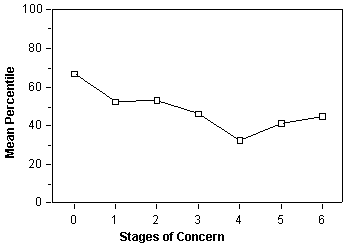 |
Index 0 : Awareness 1 : Informational 2 : Personal 3 : Management 4 : Consequence 5 : Collaboration 6 : Refocussing |
Most computer use involved word processing and therefore classes associated with areas of the curriculum requiring students to complete a substantial amount of writing were more likely to make use of the computers. These classes were English, Social Studies and Design and Technology(D&T). However, a few individual teachers incorporated the use of other specialist tool applications such as graphing, graphics and spreadsheet tools, and various databases and tools such as Maths Master and MacGlobe. These teachers tended to be associated with the curriculum areas of Social Studies, language and Science.
Over the three years the use of the computers had increased across the curriculum both quantitatively and qualitatively at the Year Eight level. The Year Eight students typically perceived that the computers were mainly used for Computing, Design and Technology, English and Social Studies and that they were not relevant in Mathematics (Table 12). A considerable amount of standard classroom work involved taking notes, reading textbooks and answering questions. These activities did not lend themselves to using a tool such as a computer and as a result the students tended to give up on trying to use the computers.
For Cohort C these data were analysed in terms of the four main class groups used for their major subjects of English, Mathematics, Science and Social Studies. Students in Class 1 estimated that they averaged about 8.5 hours of computer use in school per cycle with the other three class group averages around 6.5 hours per cycle (not significant). For this cohort it appeared that curriculum area was a more significant determinant of computer use with a class than the teacher.
| Table 12: Cohort C, Year eight student use of portable computers by subject area in 1995. | ||||
| Percentage of students in relevant group | ||||
| In class | At home | |||
| Subject class | Lots | Sometimes | Lots | Sometimes |
| English | 75 | 20 | 69 | 26 |
| Mathematics | 0 | 8 | 1 | 13 |
| Science | 33 | 42 | 40 | 48 |
| Social Science | 72 | 27 | 76 | 23 |
| Design & Technology - other | 72 | 26 | 84 | 15 |
| Computing Elective | 79 | 7 | 50 | 30 |
| French | 36 | 42 | 35 | 27 |
| Japanese | 8 | 54 | 15 | 38 |
| Table 13: Student use of portable computers by subject area (Cohort B, Year Ten). | ||||
| Percentage of students in relevant group | ||||
| In class | At home | |||
| Subject class | Lots | Sometimes | Lots | Sometimes |
| English | 28 | 48 | 67 | 30 |
| Mathematics | 1 | 33 | 1 | 14 |
| Science | 11 | 17 | 15 | 34 |
| Social Science | 25 | 43 | 34 | 47 |
| Design & Technology - other | 79 | 19 | 66 | 26 |
| Computing Elective | 26 | 11 | 13 | 13 |
| French | 10 | 55 | 9 | 64 |
At this school the tertiary entrance exams dominated the curriculum for most teachers and students, even in the lower secondary school. This discouraged innovative uses of the computers and usually relegated them to the role of a writing machine. It was perceived that students needed practice at handwritten work in all subject areas to be prepared for these exams. This perception was applied to students right down to the Year Eight level and was used as an argument for not using computers more than was done at that time.
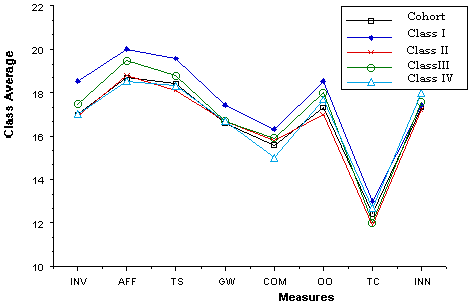
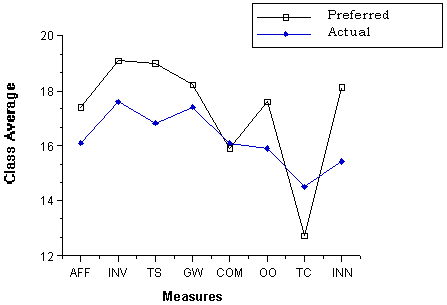
Figure 6: Preferred environment for students in Cohort B while in Year Eight, taken as a whole cohort and as four separate class groups.
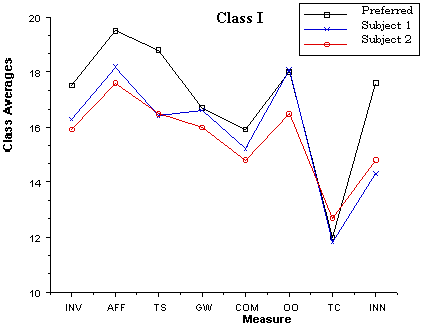
Figure 7: Comparison of preferred and actual environments for students in Class I of Cohort B while in Year Eight in two different subject classes.
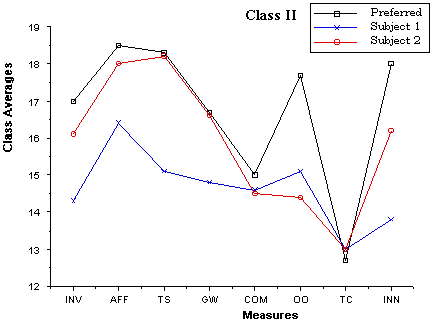
Figure 8: Comparison of preferred and actual environments for students in Class II of Cohort B while in Year Eight in two different subject classes. The two classes were taught by different teachers in each curriculum area and each class had a different teacher (i.e. there were four teachers involved). From observation of the teachers with those classes and from discussions with them they could be characterised as in Table 14. The teacher for Class II in Subject 2 made a lot of use of the computers, encouraged students to use them, used one herself, adjusted her teaching strategies to take account of the presence of the computers and had a very student-centred approach to learning. This teacher was the only teacher where the difference between actual and preferred environment on the measure Innovation was not statistically significant.
| Table 14: Descriptive characteristics of four teachers. | |
| Class and Subject | Characteristics |
| Class I Subject 1 | Accepted computers into classroom. Students encouraged to use computers. Didactic teaching strategies. |
| Class I Subject 2 | Accepted computers into classroom. Students encouraged to use computers. Combination of teaching strategies. |
| Class II Subject 1 | Not keen to accept computers into classroom. Didactic strategies. |
| Class II Subject 2 | Accommodated computers in classroom. Regularly used computers in classroom and home activities. Student-centred and open-ended teaching strategies. |
Clearly on average the students in Class II for Subject 1 perceived differences between what they preferred and what actually happened in the classroom for most of the attributes which were measured. It appeared that this teacher unconsciously discouraged the students from using the computers and on many occasions no students used their computers and many did not bother to bring their computers with them to class. The students negative perception of this classroom environment may have been heightened by the comparison with their classroom for Subject 2.
The computers were used less frequently in Subject 1 where both teachers tended to use a textbook and whole class presentations a lot of the time. Those students who used the computers used them almost exclusively for note taking and answering questions in these classes. Many students decided that because there were many tables and diagrams to copy out they would be disadvantaged by using their computers. This would account for the almost complete disappearance of the computers from one of the classrooms.
Teachers were forced to take a student-centred approach to the D&T classes because the curriculum required students to work, in groups, independently on projects. The teachers role in these classes was mainly as facilitator and guide to the students. The use of the computers for the PEN was mandated by the coordinator although from interviews with students it appeared that most students would have chosen to use the computers for this task. Most teachers involved in this program commented on the value of the computers and felt that this had helped to facilitate the student-centred approach to the curriculum.
The teacher of one of the few Year Ten classes which appeared to make substantial use of the computers, experimented with a module of work centred on the computer. This class was a lower ability group doing a special program designed and run by the teacher. She said she would not try it with other classes because they were on track for the TEE in a few years time and she also was not prepared to risk their performance in year ten. She felt that in trying to use more student-centred approaches to learning, associated with the use of computers, she may risk not completely covering the content.
In most Year Eight classes which made substantial use of the computers the teachers attempted to use a number of student-centred approaches. Three classes investigated in Cohort C had teachers who all stated that they wanted to use the computers to support a greater proportion of student-centred teaching/learning approaches. Often activities required students to collect information, prepare reports and create literature on a topic over a number of sessions, sometimes working in small groups and sometimes individually. At times the teachers insisted that the computers be used, at times they allowed the students to decide and on occasions insisted that students did not use their computers. Most of the activities were based around open-ended focus questions or small group discussion techniques. The classrooms were always set up with desks arranged in groups of about six.
Generally the students responded positively to these classes and the use of computers in them. They perceived the computer to be useful in collecting research information and presenting their information for the teacher. A majority felt that the computer helped them in their work in class and at home. They felt that their teachers could not help them with their computers but this did not perturb them.
Initial findings from questionnaires
Initial findings from interviews
The majority of students preferred to be given the choice of having a computer and did not like being forced to use their computers. Many would have liked either more classroom-based computers or some system of short term loan. The experiences of many of the students in Cohort B put them off using computers. Many did not like having to carry a file and computer and would like one or the other.
For most students the computer was used as a writing machine for assignments, essays and reports. For many students this was enhanced by including graphics with some students including graphs, animations and tables. A few individual teachers required or encouraged students to use a range of other software and to apply software such as the word processor to a wider range of tasks. For example, students from Cohort C were encouraged by a number of teachers to try note-taking and more continue to do so.
Most teachers require two or three more years of experience using computers to become facilitators of significant use of computers in their classrooms. Research has indicated that teachers need at three to five years of consistent experience in using computers to become proficient at integrating their use in the curriculum. In addition it is likely that the computers will only be used consistently in classes where the teacher attempts to make use of student-centred approaches to learning.
Newhouse, P. (1994). Creating computer supported learning environments: A three year study. In J. Steele and J. G. Hedberg (eds), Learning Environment Technology: Selected papers from LETA 94. Canberra: AJET Publications. http://www.ascilite.org.au/aset-archives/confs/edtech94/mp/newhouse.html
Plomp, T. and Pelgrum, W.J. (1992). Restructuring of schools as a consequence of computers. International Journal of Educational Research, 19, 185-195.
Rowe, H.A.H. (1993). Learning with Personal Computers. The Australian Council for Educational Research Ltd : Victoria, Australia.
| Author: Dr Paul Newhouse is a lecturer in the School of Education, Edith Cowan University, 2 Bradford St, Mt Lawley, Western Australia 6050. Ph: +61 8 9370 6469, Fax: +61 8 9370 6780, Email: p.newhouse@ecu.edu.au HomePage http://edresearch.ed.ac.cowan.edu.au/paul/
Please cite as: Newhouse, P. (1999). Portable computers supporting secondary school learning. Proceedings Western Australian Institute for Educational Research Forum 1999. http://www.waier.org.au/forums/1999/newhouse.html |